

What is SIF: The New Investment Vehicle Between Mutual Funds and PMS
Imagine walking into an astrologer’s office. Several slips of paper are placed before him, each supposedly carrying a glimpse of your future. He picks one, looks at it and begins predicting what lies ahead. Now imagine that, just for fun, the astrologer’s parrot picks the slip instead. You could jokingly call it a “fortune-telling parrot.” The investment world, too, now has something that might loosely be described as a new “fortune teller.” It does not pick slips of paper or predict the future. Instead, it attempts to identify where the market may be headed, which stocks appear expensive, where opportunities may lie and, in some circumstances, how a falling market itself may offer opportunities. Its name is SIF — Specialized Investment Fund.
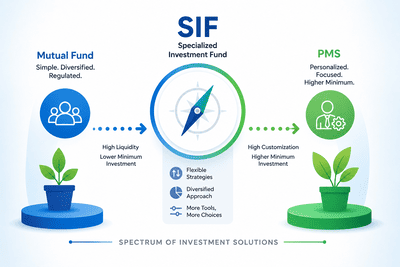
At first glance, SIF may sound like just another mutual fund. In fact, it belongs to the broader mutual fund ecosystem, but its investment framework is designed to accommodate strategies that are more flexible and sophisticated than those typically available through conventional mutual fund schemes. SEBI introduced a separate regulatory framework for SIFs on February 27, 2025, and the framework came into effect from April 1, 2025. The idea was to create an investment category between mutual funds and Portfolio Management Services (PMS), giving eligible investors access to more sophisticated investment strategies without moving all the way into the PMS structure.
What exactly is different about an SIF?
Consider a conventional equity mutual fund. Suppose you invest ₹5 lakh in one. Your money is pooled with that of thousands of other investors, and the fund manager uses the combined corpus to buy shares and other permitted securities. The manager can select stocks, increase or reduce portfolio weights and sell securities, but must operate within the investment mandate and regulatory framework applicable to that scheme. That structure is one of the great strengths of mutual funds. The rules are clearly defined, portfolios are generally diversified and investors do not have to monitor the market every day.
Now suppose a fund manager believes that some stocks are significantly undervalued while others have become excessively expensive. What if the manager could not only buy stocks expected to rise but also, within the permitted framework, take limited positions designed to benefit from a decline in certain securities? That is where some SIF strategies become interesting. Certain SIF strategies permit limited unhedged short exposure through derivatives. In other words, the manager is not restricted to asking only, “Which stock is likely to rise?” Under the relevant strategy, the manager can also consider whether an overvalued stock or sector could decline and whether that view can be expressed through an appropriate short position.
But there is an important distinction here. Shorting does not mean that an SIF automatically makes money when the market falls. A short position is itself an investment decision. If the manager expects a stock to fall from ₹1,000 but it instead rises to ₹1,200, the short position can result in a loss. The objective of an SIF is therefore not to make money in every market condition. Its attraction lies in giving the fund manager a broader toolkit for managing a portfolio across different market environments.
Why was SIF introduced?
The investment industry already has mutual funds at one end and PMS at the other. Mutual funds allow investors to participate in professionally managed, pooled portfolios within clearly defined regulatory categories. PMS, on the other hand, allows a portfolio to be managed separately for an individual investor, but currently requires a minimum investment of ₹50 lakh. SIF introduces another possibility. For a non-accredited investor, the minimum investment threshold for SIFs is ₹10 lakh. This means an investor who may not want, or may not have the capital required, to commit ₹50 lakh to a PMS but has ₹10 lakh or more available for a more sophisticated investment strategy can consider an SIF.
However, calling an SIF a “₹10 lakh PMS” would be incorrect. In a PMS, a separate portfolio is managed for you. In an SIF, you invest in units of a particular investment strategy and participate in the pooled portfolio operated under that strategy. So the structure remains closer to a mutual fund, while certain investment strategies may offer greater flexibility and access to tools such as derivatives and limited short exposure.
What is the ₹10 lakh rule?
This is one of the most important aspects to understand before investing in an SIF. For a non-accredited investor, the minimum investment threshold is ₹10 lakh across the SIF strategies offered by the fund house, considered at the PAN level. Your investments in ordinary mutual fund schemes of the same AMC do not count towards this ₹10 lakh SIF threshold.
For example, suppose you invest ₹7 lakh in an Equity Long-Short strategy and ₹3 lakh in a Hybrid Long-Short strategy offered under the SIF. Your total SIF investment is ₹10 lakh, so the threshold is met. Now suppose you also have ₹15 lakh invested in ordinary mutual fund schemes of the same AMC. That ₹15 lakh does not get added to the SIF investment for the purpose of meeting the ₹10 lakh threshold. Accredited investors are exempt from this minimum investment requirement.
There is another important point: the ₹10 lakh threshold is not simply an entry requirement. Suppose you invest ₹10 lakh in an SIF and the market subsequently falls, reducing the value of your investment to ₹8.5 lakh. You have not withdrawn any money; the value has fallen purely because of market movements. This is generally referred to as a passive breach. A passive breach is not treated in the same manner as voluntarily withdrawing money below the threshold. However, the rules do not allow you to simply redeem part of the remaining investment and continue holding ₹7 lakh in the SIF. Under the applicable framework, a passive breach can trigger a requirement to redeem the entire remaining SIF investment.
Now consider a different situation. You invested ₹10 lakh and subsequently withdrew ₹3 lakh yourself, reducing your SIF investment to ₹7 lakh. This is an active breach, because the threshold was crossed as a result of your transaction rather than market depreciation. A separate compliance mechanism applies in such circumstances. The practical takeaway is simple: ₹10 lakh is not merely an entry ticket. It is a threshold investors need to understand while maintaining their SIF investment as well.
What strategies are available under SIFs?
This is where the structure becomes particularly interesting. SEBI’s framework provides for seven investment strategies: three equity-oriented, two debt-oriented and two hybrid strategies. The names may sound complicated, but the underlying concepts are reasonably straightforward.
The first is the Equity Long-Short Fund. This strategy primarily invests in equity and equity-related instruments, while permitting limited unhedged short exposure through derivatives. At least 80% of the portfolio must be invested in equity and equity-related instruments, while unhedged derivative short exposure is capped at 25%. In simple terms, the manager can look for opportunities on both sides of the market: buying securities expected to perform well while potentially using permitted short positions where certain securities or market exposures appear unattractive.
The second is the Equity Ex-Top 100 Long-Short Fund. This strategy focuses more heavily on the equity universe outside India’s largest 100 companies by market capitalisation. At least 65% of the equity investment must be in stocks other than the top 100 companies by market capitalisation. The idea is to look beyond the largest and most familiar companies and search for opportunities among the next layer of businesses. That can create opportunities, but it can also bring greater volatility and risk.
The third equity strategy is the Sector Rotation Long-Short Fund. Here the focus shifts from individual stocks to sectors. The manager can select up to four sectors and build the portfolio around those sectors, while also having limited scope for short exposure through sector-level derivatives. For example, if the manager believes banking and manufacturing have stronger prospects while another sector appears relatively weak, the portfolio can be positioned to reflect those views within the strategy’s permitted limits.
SIFs are not limited to equities. The Debt Long-Short Fund invests in debt instruments and can use exchange-traded debt derivatives to create limited short exposure. Here the manager’s focus is less about whether a particular company’s share price will rise and more about factors such as interest rates, bond prices, maturity and duration.
The second debt strategy is the Sectoral Debt Long-Short Fund. This strategy takes a sector-oriented approach to corporate and other debt instruments. It must invest across at least two sectors, with a maximum allocation of 75% to any one sector. Limited short exposure through debt derivatives is also permitted. The objective is essentially to identify where opportunities appear stronger within the debt market and where caution may be warranted.
Then come the two hybrid strategies. The Active Asset Allocator Long-Short Fund is one of the more flexible strategies. Depending on the strategy’s permitted framework, the portfolio can allocate across different asset classes, including equity, debt, their derivatives, REITs, InvITs and commodity derivatives. The central idea is dynamic asset allocation. As market conditions change, the manager has greater flexibility to alter the portfolio’s exposure across asset classes.
The second hybrid strategy is the Hybrid Long-Short Fund. This strategy combines equity and debt. At least 25% must be invested in equity and at least 25% in debt instruments, while limited short exposure through equity and debt derivatives is permitted. The strategy therefore attempts to combine the characteristics of both asset classes rather than relying entirely on either equities or debt.
A simple way to remember the seven strategies is three equity, two debt and two hybrid. But memorising the names is less important than understanding what each strategy actually does. When you invest in an SIF, you are investing in a particular investment strategy, not simply buying a generic “SIF product.”
Mutual Fund vs SIF vs PMS
The distinction can be simplified. A conventional equity mutual fund manager may buy a company because it appears attractively valued, but must operate within the investment mandate of that scheme. An SIF manager, depending on the strategy, may have additional tools such as derivatives and limited short exposure. A PMS is different again because the portfolio is managed separately for the individual client.
The current minimum investment for PMS is ₹50 lakh, while the minimum SIF threshold for a non-accredited investor is ₹10 lakh. That makes SIF more accessible than PMS from a capital requirement perspective. But that does not make SIF less risky. A simple way to look at the three is this: mutual funds offer pooled investment, diversification and relatively straightforward strategies; SIFs offer pooled investment with access to more sophisticated and flexible strategies; and PMS offers individually managed portfolios.
The question, therefore, is not which one is “better”. The question is which structure fits the investor’s portfolio, objectives and risk tolerance.
What are the potential advantages of an SIF?
The biggest attraction is the broader toolkit available to the fund manager. Markets do not move in one direction forever. Some sectors outperform while others lag. Valuations rise and sometimes become stretched. Interest rates change. Economic cycles shift. A flexible strategy can potentially respond to these changes in ways that a traditional long-only portfolio cannot.
The ₹10 lakh threshold is another feature that may make SIFs interesting to a particular category of investors. Someone who already has a diversified portfolio, understands mutual funds and wants to allocate a portion of their capital to a sophisticated strategy may find an SIF worth evaluating.
But the minimum threshold should never become the investment target. If your entire portfolio is worth ₹20 lakh and you put ₹10 lakh into an SIF simply because ₹10 lakh is the minimum, half your portfolio would be exposed to one sophisticated strategy. That would be a very different proposition from allocating a smaller, carefully considered portion of a much larger portfolio.
SIFs operate within SEBI’s regulatory framework, and AMCs offering them must meet applicable eligibility requirements. But regulation is not a guarantee against losses. Market risk, strategy risk and fund-manager risk remain.
SIF frameworks also permit facilities such as SIP, STP and SWP, subject to the applicable strategy documents and conditions. Their availability and exact structure can vary, so investors should not assume that the rules will automatically be identical to those of a conventional mutual fund.
What are the disadvantages?
The words “long-short”, “derivatives” and “dynamic allocation” may sound sophisticated. But sophistication can also mean complexity. With a conventional mutual fund, an investor primarily needs to understand what the fund invests in and how the scheme is managed. With an SIF, there may be more to understand: the extent of short exposure, how derivatives are used, the portfolio’s net exposure, how the strategy may behave in a sharp market reversal and how the manager controls risk.
Anyone unfamiliar with these concepts should not invest simply because the product sounds sophisticated.
There is also fund-manager risk. A long-short strategy can look compelling on paper. But a poorly timed short position, an incorrect sector call or inappropriate position sizing can hurt returns. That is why looking only at the previous year’s return is not enough. Investors should also ask how much risk the manager took to generate that return.
Liquidity is another consideration. Mutual funds often create an expectation that money can be accessed relatively easily, although even mutual fund redemption terms vary. SIF strategies can have different redemption frequencies and structures. Depending on the strategy, redemption may be daily, weekly, fortnightly, monthly, quarterly or structured differently. Therefore, before investing, understand exactly when and how you can withdraw your money.
Costs also matter. Active management, derivatives, trading and sophisticated risk-management processes can result in a cost structure that differs from that of a simple index fund. Expense ratios, transaction costs, exit loads and other applicable charges should therefore be considered before comparing returns.
Who should consider an SIF?
In my view, an SIF is certainly not something every investor needs. Someone who is still learning the basics of equity mutual funds, debt funds, asset allocation and portfolio diversification does not need to start with an SIF. The fundamentals should come first.
However, an investor who already has a well-diversified portfolio, understands mutual funds, has ₹10 lakh or more that can be allocated to a specialised strategy, and is willing to understand derivatives, short exposure and the associated risks may consider allocating a portion of the portfolio to an SIF. The key words are portion of the portfolio — and, of course, only after understanding the strategy.
When a new investment product enters the market, there is a familiar question: “How much return does it give?” With SIFs, that should probably not be the first question. Start with these: What exactly does the strategy do? Where will the manager invest? When can the manager take short positions? How extensively are derivatives used? How could the strategy behave if the market moves sharply in the opposite direction? How quickly can I redeem my money? What are the costs? And most importantly, why does my existing portfolio need this strategy?
If the answers make sense, an SIF may deserve consideration. If not, there is little reason to invest merely because the product is new, the minimum threshold is ₹10 lakh or the strategy is described as being “similar to PMS.”
Is SIF a magic solution?
Certainly not. There is no rule saying that an SIF will make money whenever the market rises or whenever the market falls. In fact, derivatives and short exposure can make certain strategies more complex and, in some circumstances, more volatile.
During a strong bull market, an SIF can even underperform a conventional equity fund because its strategy may involve hedging, short positions or dynamic allocation. The objective of the strategy is not necessarily to maximise returns during every phase of a bull market.
Therefore, an SIF should not be viewed as a replacement for mutual funds or as a cheaper version of PMS. It is better understood as a specialised investment vehicle designed to address a particular portfolio requirement.
So, if you have ₹10 lakh available, there is no reason to rush into an SIF simply because you qualify. The product is relatively new. Understand the strategy. Read the documents. Study the risks. Compare the costs. Consider its place within your existing portfolio.
And then decide.
Because in investing, the most expensive mistake is often not missing an opportunity. It is investing in something you do not fully understand.
Disclaimer: SIFs are subject to market risks and returns are not guaranteed. Before investing in any SIF, investors should carefully review the applicable Investment Strategy Information Document, Scheme Information Document, risk factors, charges, redemption terms and the structure and extent of derivative and short exposure. The actual terms and features of individual SIF strategies may vary according to their respective documents. This article is intended solely for general informational purposes and does not constitute investment advice.
link to other finance articles- Finance Simplified (English)