

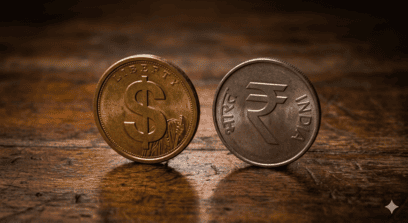
Falling Rupee. A choice?
One interesting thing I heard in Smita Prakash’s podcast with economist Sanjeev Sanyal made me look at the rupee-dollar debate differently. We often judge the strength of the Indian economy by asking a simple question: how many rupees does it take to buy one dollar? But according to the approach discussed by Sanyal, that may not be the most important question. India’s economic strategy is not necessarily about defending the rupee at a particular exchange rate. The larger objective is to keep inflation under control while allowing the economy to grow and absorb external shocks.
Sanjeev Sanyal is an economist, author and a member of the Prime Minister’s Economic Advisory Council. He has also worked extensively on economic policy and financial markets. So his explanation of the relationship between the rupee, inflation and economic growth is worth understanding.
The basic idea is fairly simple. Suppose oil prices rise sharply, American interest rates go up, global investors move money towards the dollar, or a geopolitical crisis creates uncertainty. All of these can put pressure on the rupee. If the government tries to keep the rupee at a particular level at all costs, it may have to use large amounts of foreign exchange reserves or adopt policies that could hurt domestic growth. Instead, the exchange rate can be allowed to adjust to some extent. Economists often describe this as the exchange rate acting as a shock absorber. The currency absorbs part of the external pressure, while monetary and fiscal policy can concentrate on maintaining economic stability and controlling inflation.
This does not mean that the RBI simply watches the rupee fall. It intervenes when there is excessive volatility or disorderly movement in the currency market. The objective, however, is not necessarily to ensure that the rupee remains at some predetermined number against the dollar. The objective is not to save the rupee at any cost. The objective is to protect the economy.
This also explains why inflation is such an important part of the strategy. A weaker currency can make imports more expensive, particularly crude oil. For a country like India, which imports a large proportion of its oil requirements, this can eventually feed into domestic prices. Therefore, allowing the exchange rate to adjust cannot be separated from inflation management. The interesting part is that India has managed to keep inflation within the RBI’s prescribed range while continuing to grow. Retail inflation in July 2026 was 4.45%, within the RBI’s 2–6% tolerance range, while the RBI has projected real GDP growth of 6.7% for 2026–27.
This becomes particularly significant when we look at what India has gone through over the past few years. First came COVID and the disruption of global supply chains. Then came the Russia-Ukraine war, which caused major volatility in crude oil, food and commodity prices. More recently, tensions in West Asia have once again created uncertainty around energy prices and global trade. For an oil-importing economy, these are serious external shocks. Yet India continued to grow, infrastructure investment continued and inflation did not spiral out of control. That resilience is perhaps more important than the daily movement of the rupee.
Sanyal also draws attention to the experience of countries such as Japan and China. During periods of rapid economic development, neither country treated the exchange rate as an isolated number that had to be constantly defended. Their broader economic strategies focused on industrialisation, production, exports, investment and growth. China, in particular, spent decades building enormous manufacturing and export capacity while maintaining a currency environment that supported its economic strategy. The lesson is not that a weak currency automatically produces growth. It doesn’t. The lesson is that a country’s economic strength cannot be measured simply by whether its currency is rising or falling against the US dollar.
GDP growth, productivity, manufacturing capacity, infrastructure, investment, financial stability, foreign exchange reserves and the ability to absorb external shocks matter far more. There is another interesting development taking place in the United States itself. The US Treasury has been increasing its buybacks of longer-term US government bonds. In August 2026, it increased the maximum size of individual buyback operations from $2 billion to at least $4 billion, with the stated objective of improving liquidity in the Treasury market.
This should not be interpreted as America simply “buying back its own debt because nobody wants it”. That would be an oversimplification. But it does highlight the pressures facing the world’s largest economy: enormous government borrowing, high debt levels, interest costs and the need to maintain confidence and liquidity in the Treasury market. These issues have also contributed to concerns about the long-term strength of the dollar.
So the global currency story is much more complicated than “dollar strong, rupee weak, therefore India is in trouble.” The dollar itself is affected by America’s fiscal position, interest rates, Treasury yields, global capital flows and confidence in US economic policy. At the same time, the rupee is influenced by India’s inflation, oil imports, capital flows, interest rates and overall economic growth.
This is why the more meaningful question for India is not simply, “What is the rupee-dollar exchange rate today?” It is whether India is growing, whether inflation is under control, whether investment is continuing, whether infrastructure is improving and whether the economy can absorb major global shocks. On those parameters, the picture is considerably more interesting.
The strategy discussed by Sanyal can therefore be understood in one sentence: India does not need to win a daily battle against the dollar. It needs to keep its economy growing while keeping inflation under control. If the rupee adjusts gradually as global conditions change, that is not necessarily a sign of economic failure. Sometimes allowing the exchange rate to adjust is precisely what allows the rest of the economy to remain stable.
And that is perhaps the most interesting takeaway from the podcast. The strength of an economy is not determined by how strong its currency looks against the dollar. It is determined by how well that economy continues to function when the world around it becomes difficult.
link to our finance related section – Finance Simplified (English)
link to our English section- English
Do read Marathi short stories – लघुकथा