

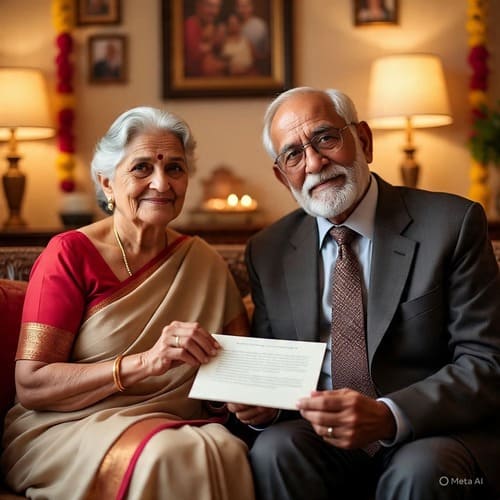
A few days ago, during a casual conversation, I asked one of my uncles, “So, have you prepared your Will?” The moment he heard the question, he looked annoyed. “Are you waiting for me to die? And let me make one thing clear—you aren’t getting anything from me!” he said, only half-joking. I smiled and replied, “Uncle, I don’t want anything from you. But if you don’t leave behind a Will, the people you actually want to inherit your assets may have to struggle to receive them. They could end up dealing with unnecessary paperwork, lengthy legal procedures, and sometimes even family disputes.” Like my uncle, many people react emotionally whenever the subject of a Will comes up. They instinctively associate it with death. Some consider it inauspicious, while others feel that writing a Will somehow means they are preparing for the end of their life. In reality, nothing could be further from the truth.
A Will has nothing to do with inviting death. If we look at it from a different perspective, it is simply the final act of responsible planning for the people we love. We build homes, buy insurance, save money in banks, invest in financial assets and make plans for our children’s education because we want to secure the future. If all these decisions are considered financial planning, then deciding how our hard-earned assets should be distributed after our lifetime is equally important. A Will is not about death; it is about ensuring that the future remains orderly for those we leave behind.
We often see examples of this in our own society. Many parents, after reaching their sixties or seventies, transfer ownership of their house, agricultural land, apartment, shop or other assets to their children out of affection or emotion. At that point, everything appears perfectly normal. However, circumstances can change with time. Children get married, financial priorities evolve and differences within the family begin to surface. In some unfortunate cases, elderly parents find themselves feeling like strangers in their own home. Some are neglected, some are forced to leave the very property they once owned and others are compelled to seek legal remedies simply to protect their rights. Of course, this does not mean every child behaves this way. Most sons and daughters care deeply for their parents and support them throughout their lives. Even so, it is worth asking whether handing over complete ownership of everything you have built while you are still alive is always the wisest decision.
This is precisely where a Will becomes valuable. It allows you to remain the absolute owner of your assets for as long as you live. You can continue living in your home, rent it out, sell it, modify it or deal with it in any way you choose. At the same time, you can clearly specify who should inherit each asset after your death and in what proportion. In simple terms, a Will is a legally recognised and well-organised method of transferring wealth to the next generation. Many financially successful people understand this and prepare Wills as a routine part of estate planning. Ironically, it is often ordinary individuals who avoid doing so because they mistakenly believe that writing a Will is equivalent to preparing for death.
The real question, therefore, is what happens if there is no Will. Imagine a person who owns an apartment in Mumbai, agricultural land in their native village, bank deposits, investments, shares and other financial assets but dies without leaving a Will. Questions immediately arise. Who are the legal heirs? Who is entitled to which asset? How should different properties be divided? What if one of the heirs lives abroad or certain documents cannot be located? Banks, mutual fund companies, depository participants managing Demat accounts, housing societies and government authorities often require numerous legal documents before transferring ownership. In many situations, the family may have to obtain legal heir certificates, succession certificates or even approach the courts. As a result, assets can remain inaccessible for months or even years. Sadly, in many families, relationships suffer greater damage than the value of the property itself. A Will is therefore not merely a document for distributing wealth; it is often one of the most effective ways to prevent unnecessary disputes within a family.
Its importance becomes even greater in certain situations. If a person has remarried, has no children, has a child with special needs, owns multiple properties, has both ancestral and self-acquired assets or wishes to leave part of their estate to a charitable organisation, a properly drafted Will becomes indispensable. Without one, the legal process for the next generation can become significantly more complicated.
Many people also assume that preparing a Will is a complicated legal exercise. In fact, it is surprisingly straightforward. Indian law does not prescribe any fixed format for making a valid Will. It can be written on plain paper, and the use of stamp paper is not mandatory. A Will may be handwritten or typed, and both forms are legally acceptable. What matters is that certain essential details are clearly mentioned. The document should contain the full name, address and identity of the person making the Will. It should clearly state that it is the person’s final Will, made voluntarily and without any coercion. The details of every asset should be recorded carefully, including properties, bank accounts, Demat accounts, jewellery, investments and any other valuable possessions. The beneficiaries should also be identified with complete clarity, along with the exact share or asset each of them is intended to receive. Ambiguous statements often become the root cause of future disputes, so clarity is one of the greatest strengths of a well-drafted Will.
The Will must bear the signature of the person making it. In addition, Indian law requires the signatures of at least two witnesses. These witnesses should either have seen the person sign the document or should acknowledge that the signature belongs to them. As a matter of good practice, beneficiaries should preferably not act as witnesses. Although the law does not make the appointment of an Executor compulsory, doing so is highly advisable. An Executor is the person responsible for carrying out the instructions contained in the Will. A trusted family member, friend, Chartered Accountant or lawyer can perform this role, and appointing one often makes the entire process smoother for the family.
Similarly, a doctor’s certificate is not mandatory for every Will. However, if the person making the Will is elderly, seriously ill or likely to have their mental capacity questioned in the future, obtaining a medical certificate confirming that they were of sound mind can prove extremely useful. It significantly reduces the possibility of future legal disputes. Registration of a Will is also optional under Indian law, but it offers several practical advantages. A registered Will is less likely to be lost, helps discourage fraudulent documents and may enjoy greater credibility if challenged before a court.
Another important point that people often overlook is that a Will is not a document you prepare once and forget forever. Life changes continuously. New assets are acquired, existing ones are sold, families grow, children are born, marriages take place and circumstances evolve. For this reason, a Will should be reviewed from time to time. A person is free to make a new Will whenever necessary during their lifetime, and generally the most recent valid Will supersedes all previous versions. Keeping it updated ensures that it continues to reflect your true intentions.
The wealth we accumulate over a lifetime represents far more than money. It embodies years of hard work, sacrifice, perseverance and dreams built for our family. Every individual has the right to decide what should happen to that legacy after they are gone. That is why a Will should never be viewed as preparation for death. It is an expression of responsibility towards those we care about. It helps preserve harmony within a family, protects relationships from avoidable conflicts and ensures that our wishes are respected even when we are no longer around to express them ourselves.
This article is intended only to create general awareness about the importance of making a Will and should not be treated as legal advice. Estate planning laws can involve technical issues depending on individual circumstances, and consulting a qualified legal professional is always advisable before preparing or executing a Will. The purpose of this article is simple: to encourage people to let go of the misconception that “making a Will means preparing for death.” In truth, making a Will is one of the most thoughtful, responsible and caring decisions you can make for your family. The question is will you will?
© Mandar Jog